
Find Mille Lacs County Police Blotter Records
Mille Lacs County Police Blotter records are maintained by the Mille Lacs County Sheriff's Office in Milaca, which serves this east-central Minnesota county bordered by the namesake lake to the west. The sheriff's office publishes press releases and mortgage foreclosure lists on its website, and jail in-custody data is published by the Brainerd Dispatch without a subscription requirement. Tribal police from the Mille Lacs Band of Ojibwe also have concurrent jurisdiction in parts of the county, adding a second agency to track for complete blotter coverage.
Mille Lacs County Sheriff's Office
The Mille Lacs County Sheriff's Office is at 640 3rd St SE, Milaca, MN 56353. Sheriff Kyle A. Burton leads the department. Chief Deputy Aaron Evenson serves as the second in command. Main phone: (320) 983-8250. Jail: (320) 983-8244. Dispatch: (320) 983-8257. The office website is at millelacs.mn.gov.
The sheriff's office maintains press releases and some documents on its website. Mortgage Foreclosure Lists, which can be relevant for property-related research, are also posted online. For incident reports and formal Police Blotter records, in-person or phone requests to the office are the standard approach.
Jail In-Custody Data
Mille Lacs County jail in-custody information is published by the Brainerd Dispatch at their jail in-custody page. This data is available without a subscription, making it one of the more accessible pieces of Police Blotter information for this county. The listing shows who is currently held at the jail and is updated regularly. It is a useful first stop if you are checking whether someone is in custody before calling the jail directly.
The screenshot below shows the Minnesota Courts website, which complements local jail data by providing case records for Mille Lacs County incidents that reached the court system.
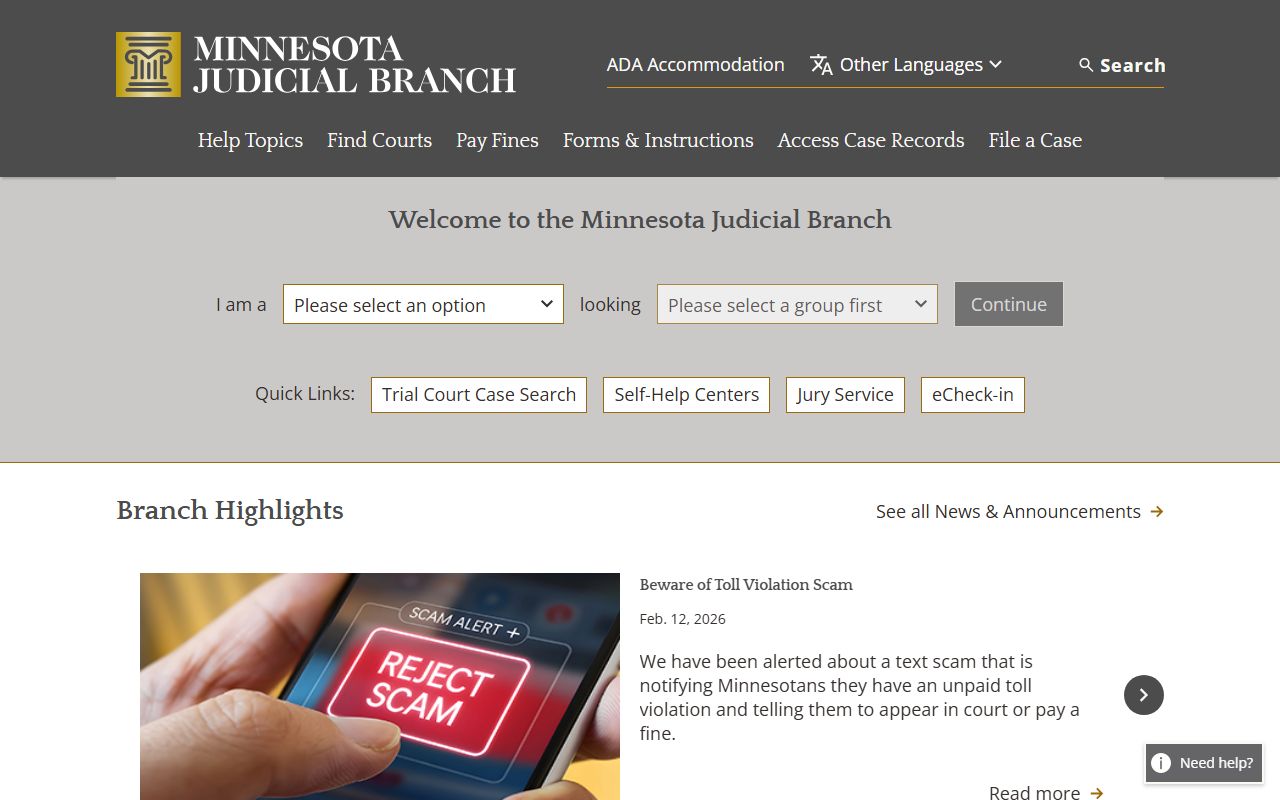
The courts website covers all of Minnesota's 87 counties, including Mille Lacs, and can be searched by name, case number, or court location.
Tribal Police and Concurrent Jurisdiction
The Mille Lacs Band of Ojibwe maintains its own police force that operates with concurrent jurisdiction in parts of Mille Lacs County. The tribal police District I station is at 43408 Oodena Dr., Onamia, MN 56359. Phone: 320-532-3430. If an incident occurred on or near tribal land, tribal police may have responded either alone or alongside county deputies. Records held by the tribal department are not subject to the Minnesota Government Data Practices Act in the same way county records are, since the tribe operates as a sovereign government with its own rules.
If you are researching a specific incident and are not sure which agency responded, call the sheriff's dispatch at (320) 983-8257. They can usually tell you which officers were on scene and point you to the right place for records. For drug-related tips, the Mille Lacs Band Drug Tip Hotline is 320-630-2458.
Requesting Police Blotter Records
Under Minn. Stat. § 13.82, Minnesota law enforcement agencies must disclose basic arrest data to the public. This includes the name of the person arrested, when and where the arrest occurred, the offense, and the arresting officer. This data is public by law and cannot be withheld. The Minnesota Government Data Practices Act, Minn. Stat. § 13.03, further requires agencies to respond to data requests promptly and to explain any withholding of information.
To make a request, contact the Mille Lacs County Sheriff's Office directly. The office at 640 3rd St SE in Milaca handles records for the county. Bring a photo ID, know the date range and type of incident, and be prepared for possible copy fees. The office can tell you upfront what the fees are and how long processing will take.
Statewide Data Resources
The Minnesota Courts website provides public access to court case records statewide. Mille Lacs County cases are heard in the Seventh Judicial District. Court records show whether charges were filed after an arrest and what happened at each stage of the case. Combined with Police Blotter data, they give a more complete view of any incident.
The VineLink system lets anyone check the current custody status of an individual held in a Minnesota jail or correctional facility. VineLink covers the Mille Lacs County jail. Registered users can set up automatic alerts when a person's custody status changes. This is a free service and does not require any formal records request.
For broader statewide criminal history records, the Minnesota Bureau of Criminal Apprehension manages comprehensive data that goes beyond what the local blotter shows. The BCA supports local agencies with investigative resources and handles background check requests from the public.
Community Crime Map
Check Community Crime Map to see whether Mille Lacs County agencies share data on this public tool. Coverage varies. For areas near the lake or around Onamia and Milaca, the map may show incident data if local agencies participate. The Minnesota Sheriffs' Association is another resource if you need guidance on how to navigate the records request process in any Minnesota county.
Nearby Counties
Mille Lacs County is bordered by several other central and east-central Minnesota counties. If an incident crossed county lines or you need to check with a neighboring agency, these links will help.
- Kanabec County - county seat Mora
- Aitkin County - county seat Aitkin
- Morrison County - county seat Little Falls
- Isanti County - county seat Cambridge
Practical Notes on Blotter Research
Mille Lacs County sits in an area with significant outdoor recreation and tourism around the lake, which means there is seasonal variation in law enforcement activity. Incidents during the fishing opener and summer months tend to spike. If you are researching incident data for a specific time of year, that context matters when reading the blotter.
The county is also near the tribal gaming facilities associated with the Mille Lacs Band, which can sometimes generate calls near those locations. As noted, incidents near tribal facilities may involve both tribal and county law enforcement. If a case crossed between tribal and county jurisdiction, records may be split across two agencies and two separate legal frameworks. Plan for that when doing thorough research.