
St. Paul Police Blotter Records
The Saint Paul Police Department maintains public records under Minnesota's Government Data Practices Act, giving residents access to police blotter data, incident reports, and other law enforcement records created by one of the state's oldest and largest police agencies. St. Paul serves as the capital of Minnesota and the county seat of Ramsey County, and its police department handles a wide range of calls across diverse neighborhoods that stretch from the river bluffs to the eastern suburbs. If you need a copy of a report, a records check, or want to understand what data is publicly available, this page covers the process from start to finish.
Saint Paul Police Department
The Saint Paul Police Department is one of Minnesota's largest municipal law enforcement agencies. It serves a city of over 300,000 people spread across 56 square miles. The department handles thousands of calls each year, ranging from minor disturbances to serious violent crimes. Officers work out of several district offices in addition to the main headquarters. The department has a dedicated support services division that handles records requests from the public, attorneys, insurance companies, and other agencies.
The Records and Identification Unit is the right place to start when you need a copy of a police report or a local records check. You can find department information at the Saint Paul Police Department website. For non-emergency matters, call 651-291-1111. This line is staffed around the clock, but records staff work standard business hours.
Records staff can help with incident reports, crash reports, background checks, and data requests. They do not handle records created by other agencies. If you need a report from the Minnesota State Patrol, University of Minnesota Police, Metro Transit Police, or a suburban department, you will need to contact that agency directly. The Saint Paul Police Department only releases records it created.
The police records page lists the types of records the department maintains. These include incident reports, crash and accident reports, local records checks, body camera video, police photographs, police interview audio, 911 transcripts, CCTV camera video, and police in-car camera footage. Not all of this data is public. Some records are classified as private or protected under state law.
What Is a Police Blotter?
A police blotter is a log of activity recorded by a law enforcement agency. It typically includes the date and time of an incident, the location, the type of call, and the case number. Some departments publish daily or weekly blotter summaries online. Others release this data only when requested. The blotter gives the public a general picture of where and when police activity is occurring without disclosing private details about victims or ongoing investigations.
In St. Paul, the police blotter functions as a public record under Minn. Stat. § 13.82, which governs law enforcement data. This statute defines what parts of a law enforcement record are public and what parts are private. The public portion of an arrest record, for example, includes the subject's name and date of birth, the time and place of arrest, the charge, and the identity of the arresting officer. Private data includes ongoing investigative notes, victim information, and certain witness details.
Understanding this distinction matters when you submit a request. You can ask for public data at no charge. Requests for non-public data may be denied unless you are the subject of the record or have a legal basis to access it. The department will tell you what data is public and what is not before charging you for a search.
Police Blotter Fee Schedule
The Saint Paul Police Department charges fees for some types of records. Fees vary based on the type of record and the format you need. Here is what to expect:
- Police reports: $0.25 per page for the first 99 pages; actual cost for 100 or more pages
- 911 transcripts: $25 per hour of staff time
- Body camera video: $30 per CD
- CCTV camera video: $30 per CD
- Dash camera video: $30 per CD
- Photographs: $15 per CD
- All other data: actual cost of search and retrieval
Payment is accepted by cash, check, or money order. Online payment is not available. If you plan to pick up records in person, bring exact change or a check made out to the City of Saint Paul. Mail-in requests should include a check or money order. The department may require prepayment for large or complex requests before beginning the search.
How to Request Records
Start by visiting the police records page on the city's website. You can submit a request in person, by mail, or by phone. Online submission options may also be available through the city's general records portal. When you make a request, include as much detail as possible: the date of the incident, the location, names of people involved, and the case number if you have it. A specific request gets a faster response than a broad one.
The department has five business days to respond to your request. If the records are not immediately available, staff will let you know when to expect them. For large requests or records that require review before release, the timeline may be longer. If your request is denied in whole or in part, you have the right to appeal. The state's Department of Administration handles appeals under Minn. Stat. § 13.03.
State law sets the framework for how government agencies handle data requests. Section 13.03 requires agencies to maintain records in a way that allows the public to access non-private data. Agencies must respond to requests promptly and cannot charge more than the actual cost of searching and copying. These rules apply to the Saint Paul Police Department just as they apply to any other government body in Minnesota.
Minnesota Court Records and Other Sources
Police blotter data covers what officers recorded in the field. Court records cover what happened after an arrest. If you want to know whether a case went to trial, what the verdict was, or whether someone received a sentence, you need court records rather than police records. Minnesota Court Records Online (MCRO) at mncourts.gov lets you search case records statewide. Some records are available to the public; others are sealed or restricted.
Ramsey County District Court handles cases originating in St. Paul. Criminal cases, civil matters, and family court files are all maintained there. The court clerk's office can assist with in-person searches if you need records not available online. Ramsey County records are part of the statewide court system, so MCRO is usually the best starting point.
For county-level law enforcement records, the Ramsey County Sheriff's Office is a separate agency from the Saint Paul Police Department. The sheriff's office is located at 1411 Paul Kirkwold Drive, Arden Hills, MN 55112, and can be reached at (651) 266-9333. Business hours are Monday through Friday, 8 a.m. to 4:30 p.m. Note that the Ramsey County Sheriff does not release reports created by the Saint Paul Police Department, the MN State Patrol, University of Minnesota Police, Metro Transit Police, or suburban departments. You must go to the originating agency for those records.
For criminal history arrest records at the county level, the Ramsey County Sheriff requires a written request that includes the subject's full name, date of birth, number of copies needed, and the reason for the request.
St. Paul Police Blotter: Public Data Access
The Saint Paul Police Department's public-facing records resources are a good starting point for understanding what the department makes available. The city's website provides access to department policies, press releases, and some statistical data. For more detailed records, a formal request is required.
The department's website offers information on how to navigate the data request process. You can learn about the Saint Paul Police Department's services and records processes through the city's official site.
For a closer look at the legal framework governing police data in Minnesota, the St. Paul Police Department's homepage connects to relevant city resources, while the Minnesota statutes provide the full legal text.
The Saint Paul Police Department's official website provides department information, records access guidance, and contact details for the records unit. Visit stpaul.gov/departments/police to start a records request or learn more about available data.
Minnesota law enforcement records are governed by state data practices law, which defines public and private data classifications for police blotter records.
The state statute that applies most directly to police records is Minn. Stat. § 13.82. This law spells out what parts of a law enforcement record are public and what parts are private or protected. Knowing the statute helps you ask the right questions and understand why some requests may be partially fulfilled rather than fully released.
Minnesota Statute 13.82 governs the classification of law enforcement data, including police blotter records, arrest data, and incident information. View the full text at revisor.mn.gov.
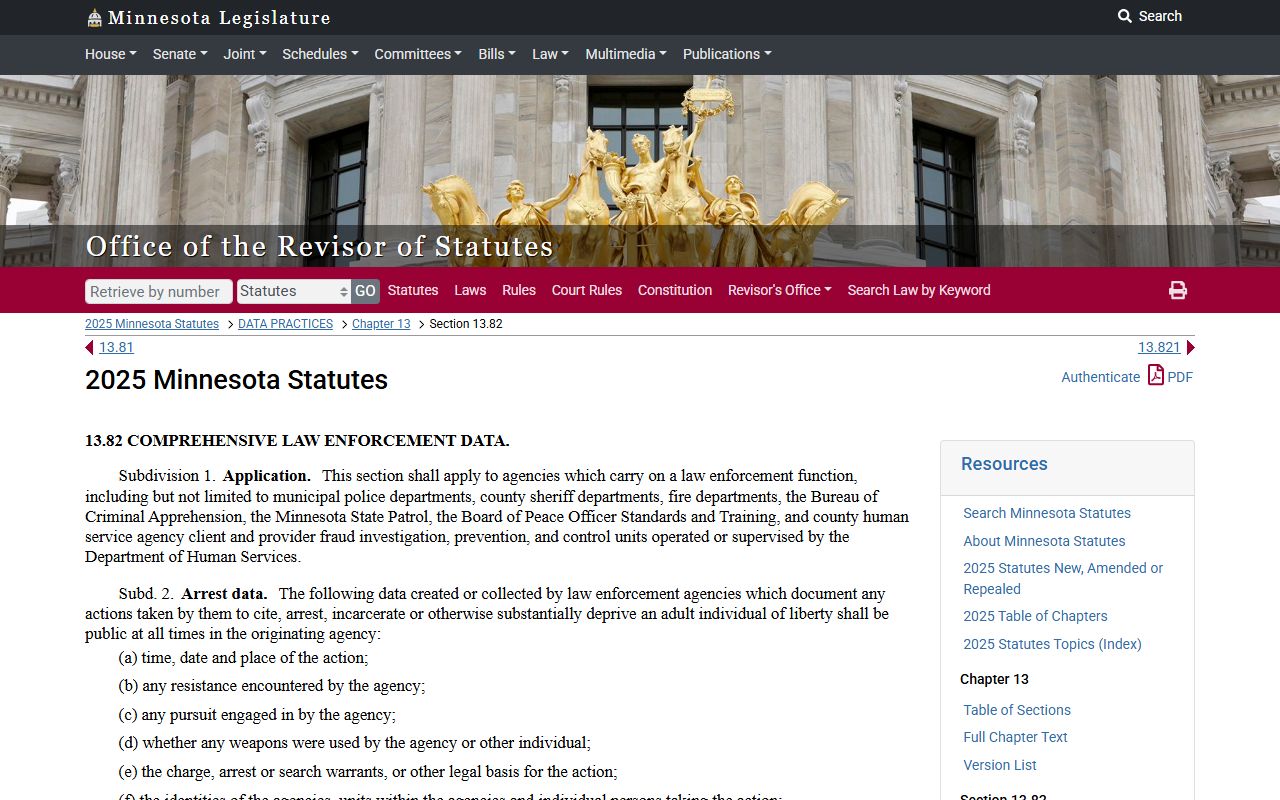
Section 13.82 of the Minnesota Government Data Practices Act defines what law enforcement data is accessible to the public and what data is classified as private.
Serving Ramsey County
St. Paul is the county seat of Ramsey County. All criminal cases filed in St. Paul are handled by the Ramsey County District Court. The county government also provides services that overlap with city police functions, including the county jail and the county attorney's office, which decides whether to prosecute cases that officers bring in. Understanding the connection between the city police department and county government helps you navigate the records landscape more effectively.
Nearby Cities
If you need police blotter records from other cities in the Twin Cities metro area, the following qualifying cities have their own pages: